
Tankless vs. Tank Water Heaters for Rhode Island Homes
Neal Lund
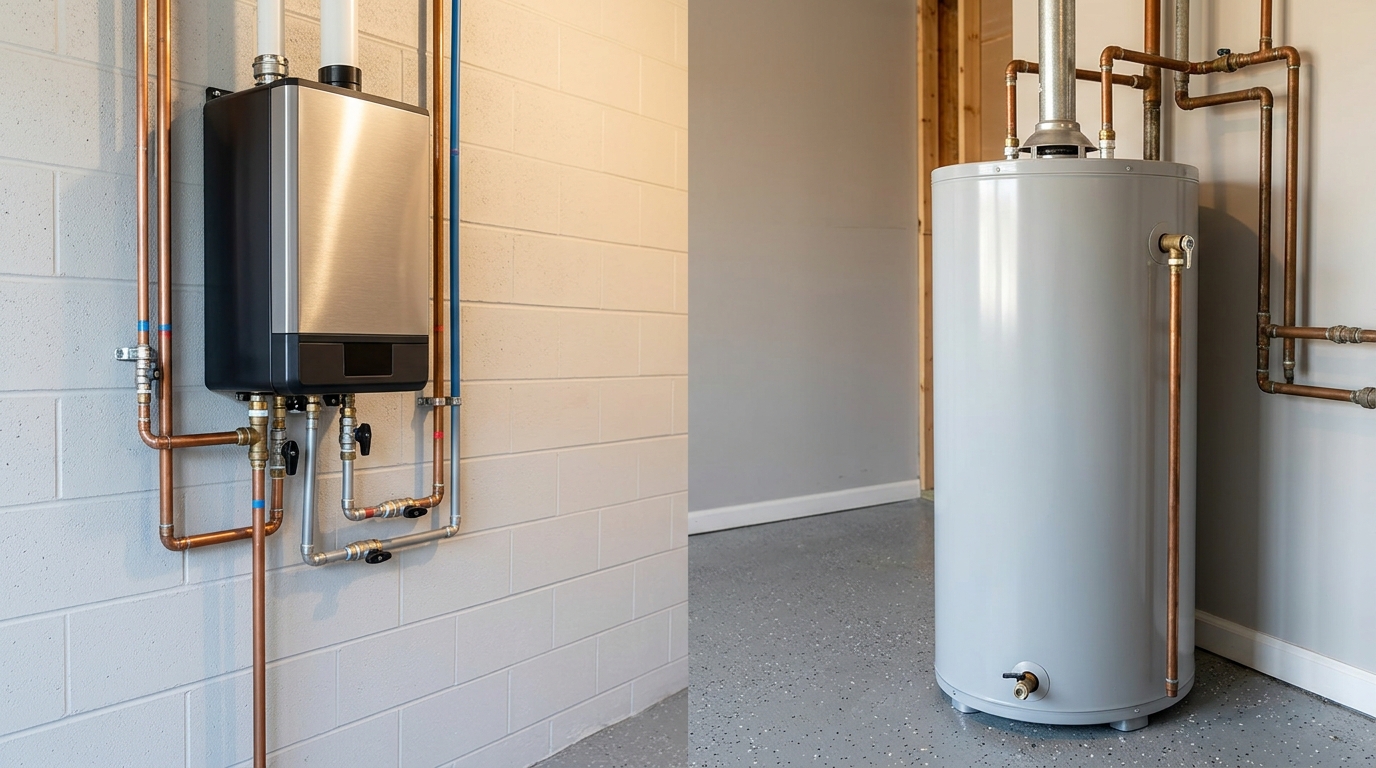
Tankless water heaters provide hot water on demand, take up far less room, and generally last longer than conventional tanks—but they typically require a larger upfront investment. Traditional tank water heaters cost less to install and can be an excellent fit for many Rhode Island homes, but they store a limited supply of hot water and require dedicated floor space. The right choice depends on your household’s hot-water habits, available fuel, mechanical setup, and long-term plans.
For homeowners in Providence, RI, and throughout Rhode Island, replacing a water heater is about more than choosing a model off the shelf. Your existing plumbing, heating equipment, venting, electrical capacity, and family’s daily routine all matter. F.G. Lees & Son helps homeowners evaluate the practical tradeoffs so they can invest confidently in reliable hot water.
How Traditional Tank Water Heaters Work
A conventional water heater stores a set volume of heated water—commonly 40, 50, 65, or 75 gallons—until a faucet, shower, washing machine, or dishwasher calls for it. As hot water leaves the tank, cold water enters to be heated in its place. This design is familiar, dependable, and often the most affordable replacement option.
The limitation is recovery time. A busy morning with several showers, laundry, and dishes can draw down the tank’s usable hot-water supply. Once the stored hot water is depleted, you may need to wait for the unit to recover. Tanks also continuously maintain the temperature of stored water, which creates standby energy loss even when no one is using hot water.
Still, a properly sized storage tank is a smart choice for many Rhode Island households. It can be especially practical when replacing an existing unit in the same location, when the budget is a primary concern, or when the home’s existing fuel and venting arrangement supports a straightforward installation.
How Tankless Water Heaters Work
A tankless water heater heats water only when you need it. When a hot-water fixture opens, cold water flows through the unit and is heated by a gas burner or electric elements before reaching the fixture. There is no reservoir of stored hot water to run out.
That on-demand design is particularly appealing for Rhode Island homes with tight utility rooms, finished basements, or limited storage space. Wall-mounted tankless units free up valuable square footage and can provide a continuous supply of hot water as long as the system is properly sized for simultaneous demand.
Tankless equipment usually has a higher purchase and installation cost than a standard tank. Installation may also involve changes to gas piping, electrical service, venting, condensate drainage, or water piping. In return, homeowners can gain greater efficiency, a longer typical service life, and hot water that does not depend on a finite tank capacity.
Fuel Types: Gas, Electric, Oil-Fired, and Indirect Water Heaters
Natural gas water heaters
are common in Providence and other areas served by gas infrastructure. Both storage and tankless gas models are available. A gas tankless system can deliver strong performance, but it must have adequate gas supply, correct venting, and enough capacity to meet the home’s peak hot-water demand.
Electric water heaters
are available in tank and tankless configurations. Conventional electric tanks are often straightforward to install where gas is unavailable. Whole-home electric tankless units, however, can require substantial electrical capacity and may not be the right fit for every home. Electric heat-pump water heaters are another tank-based option worth discussing when efficiency is a priority and the installation space is suitable.
Oil-fired water heaters
can be a sensible choice for homes already using oil, particularly when the existing setup supports it. They can offer fast recovery, but equipment condition, fuel costs, venting, and maintenance needs should all be considered before replacing like for like.
Indirect water heaters
use a boiler as their heat source. Rather than firing independently, an indirect tank relies on the boiler’s heating capacity to produce domestic hot water. For homes with a well-maintained boiler, an indirect can be highly efficient and provide excellent recovery. F.G. Lees & Son can evaluate whether an indirect tank or a high-efficiency boiler-and-hot-water solution makes sense; explore our Boiler Services
for more information.
Choosing the Right Size for Your Household
Sizing is one of the most important parts of water-heater replacement. For a storage tank, household size offers a useful starting point: many one- to two-person homes do well with approximately 30 to 40 gallons, while a family of three to four may need 40 to 55 gallons. Larger families, soaking tubs, high-flow showers, or frequent back-to-back use can justify 65 gallons or more. Fuel type and recovery rate can change the calculation, so tank size alone does not tell the whole story.
For a tankless unit, the key measurement is flow rate at a given temperature rise. In Rhode Island winters, incoming water can be very cold, so a unit must work harder to raise it to shower temperature. A home that wants to run two showers and a dishwasher at the same time needs more capacity than a home with one bathroom and lighter demand. F.G. Lees & Son looks at fixture count, simultaneous use, incoming water temperature, and fuel availability—not just the number of bedrooms.
Why Consider a Navien Tankless Water Heater?
Navien is a well-known high-efficiency option for homeowners considering tankless water heating. A properly selected Navien system can offer dependable on-demand hot water, compact installation, and advanced efficiency features. F.G. Lees & Son is certified to install high-efficiency Navien equipment, giving Rhode Island homeowners an experienced resource for system selection, installation, and ongoing service.
Tankless equipment is not automatically the best answer for every property. An older Providence home may need upgrades before a tankless installation is practical, while another home may be an ideal candidate. Our team can explain the expected scope clearly, including any needed gas, venting, electrical, or drainage work.
Rhode Island Energy Rebates May Affect the Decision
Rebates can make an efficient replacement more attractive. For qualifying installations completed in 2026, Rhode Island Energy lists rebates of up to $600 for eligible high-efficiency natural-gas on-demand tankless and storage water heaters. It also offers rebates for qualifying electric heat-pump water heaters, subject to equipment, customer-account, replacement, installation, and application requirements.
Rebate programs, qualifying product lists, amounts, deadlines, and funding can change. Before purchasing equipment, ask F.G. Lees & Son to review the current Rhode Island Energy requirements and whether your proposed water heater may qualify. A licensed installation and complete documentation are important parts of the process.
FAQ
Is a tankless water heater worth it in Rhode Island?
It can be, especially for households that value continuous hot water, need to reclaim space, or expect to stay in the home long enough to benefit from efficiency and longevity. The best choice depends on installation requirements and usage patterns.
Will a tankless water heater work during a Rhode Island winter?
Yes, when it is correctly sized for the colder incoming-water temperatures common during winter. Proper sizing is essential for maintaining comfortable flow when multiple fixtures are running.
How long do tank and tankless water heaters last?
Traditional tanks commonly have a shorter service life than tankless systems, though actual longevity depends on water conditions, installation quality, maintenance, and use. Routine service helps either type perform more reliably.
Can I replace an oil-fired water heater with a tankless unit?
Possibly. The answer depends on whether natural gas or sufficient electrical capacity is available, along with venting, piping, and the overall heating-system design. An on-site assessment provides the clearest answer.
Who should install my new water heater?
Choose a qualified plumbing and heating professional who can size the unit correctly and assess the entire installation—not simply swap equipment. For installation, repair, and replacement guidance, visit F.G. Lees & Son’s Water Heater Services.
Whether you are comparing a cost-effective tank replacement, an indirect water heater, or a high-efficiency Navien tankless system, F.G. Lees & Son is ready to help. Contact our Providence, RI team today to get a personalized quote for your Rhode Island home.